

“Horsetails can be considered living fossils. This group of plants is what is left of a group of plants that were as thick as forests and had relatives as big as trees that flourished during the Devonian period approximately 350 million years ago.” Purdue Extension Weed Science
Horsetail stems are jointed and hollow. They do not appear to have leaves; their leaves are reduced to small scales. These plants require no pollination; they have no flowers – reproduction is by spores. Some stems are fertile and some sterile; The little brown cone at the end of the fertile stem is the part that produces spores. It is the sterile stems that produce energy through photosynthesis
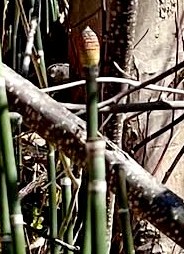
As the fertile stems wither, the sterile, chlorophyll-producing secondary stems appear, covered with whorls of feathery green branches. The energy they gather through photosynthesis goes to underground tubers for storage, allowing horsetail to survive harsh winters and periods of drought.
(Thanks to trishaw pilot John Newman for the photos.)

 The Mascoma River Greenway