Thanks to Dan Moriarty for this tale of the missing Mile Marker!
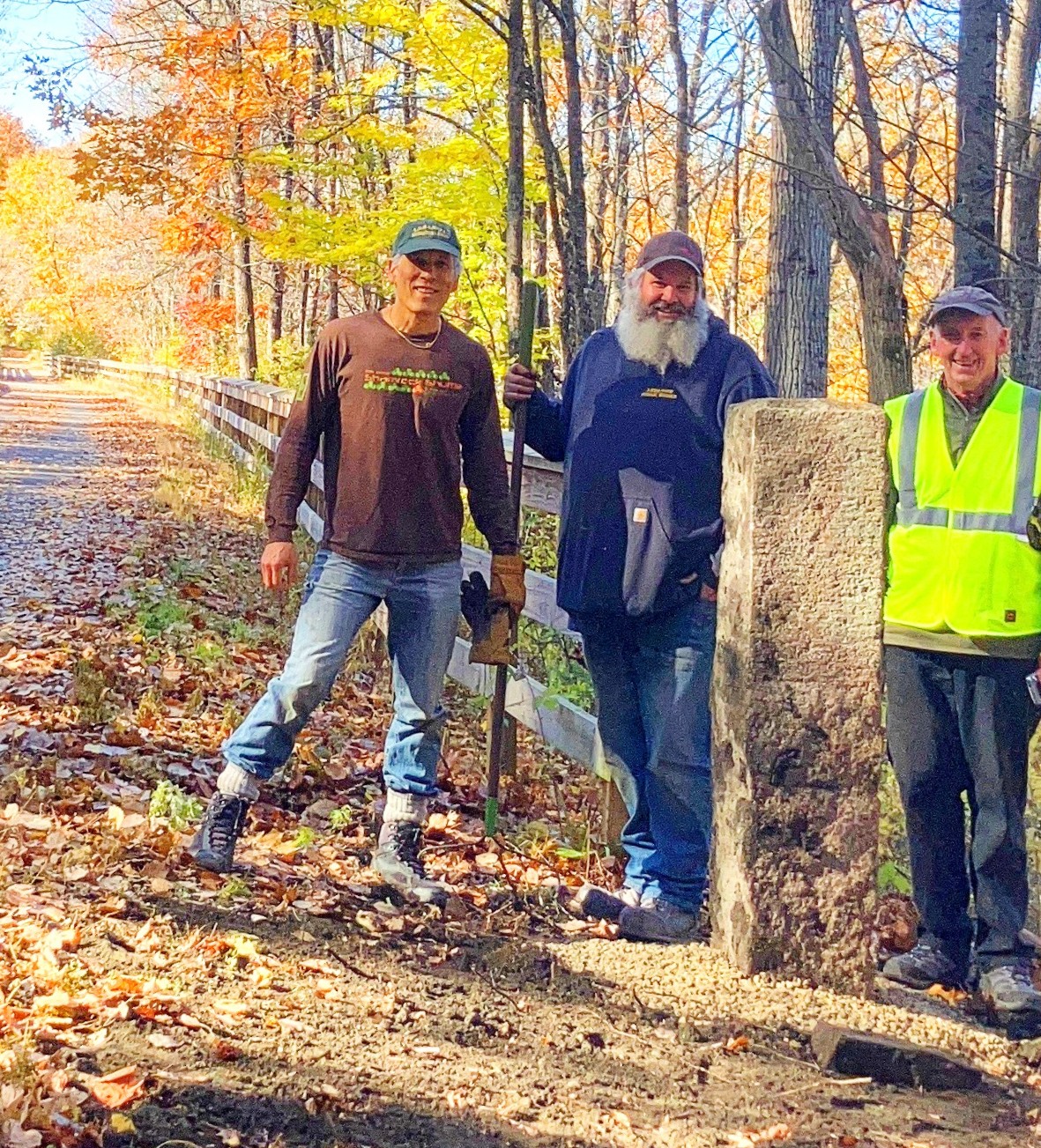
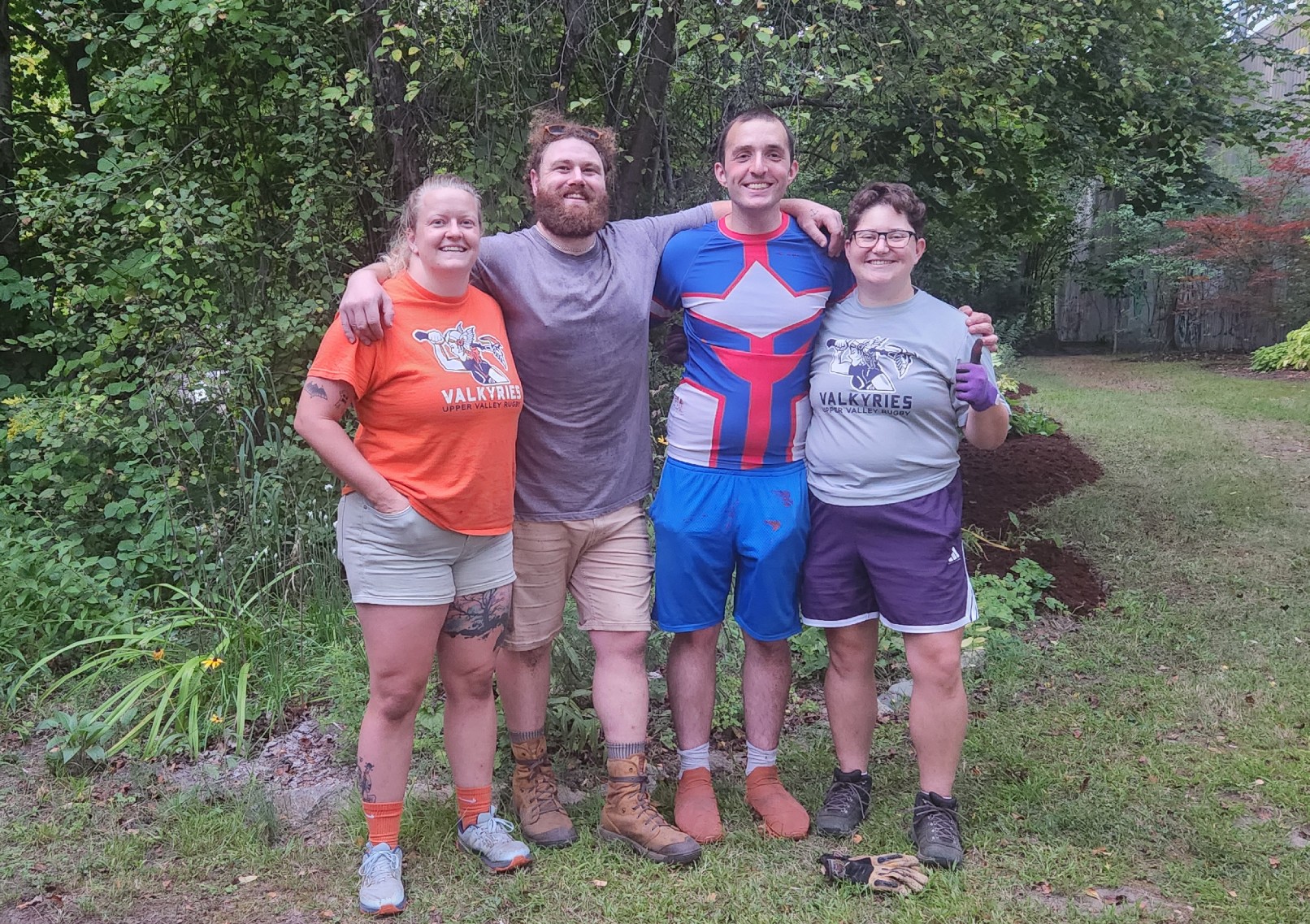
The triumphant trio who managed to find, haul, and install Mile Marker B140/WRJ3. (Left to right: Paul Coats, Shane Smith, Dan Moriarty)
Background Info for Finding, Relocating & Restoring B140/WRJ3
“I have walked or ridden on the MRG since its completion in 2018. My initial acquaintance with it centered around wildlife walks before sunup and to see what wasl ooking back at me in the dark. I would do a round-trip walk/ride from School St. to the Glen Road gate on the MRG. During those excursions, I noted two old Boston & Maine rail line mileposts on the MRG. The mileposts were placed aside of the old rail line originally between 1901-1905 to note the distance from Concord to WRJ, VT and then around 1920 were changed to note the distance between North Station in Boston to WRJ, VT. Each milepost designated one mile of rail line. One milepost was located above Jake’s Market (B139/WRJ4) and the other at the Glen Road gate (B141/WRJ2). There were two miles between them. There was one missing: B140/WRJ3. I am a history nut, so I wanted to know where B140/WRJ3 was. I wanted to find it or figure out if ,in my tenure as President of the Friends of Leb Rec, we could order a replacement or signage to replace the missing milepost.
I used the internet to research the B&M rail line that ran from Boston to White River J unction, VT via Concord, NH. During those searches, I came across a publication by Ed Hiller, a historian from Andover, NH. The publication was entitled “Restoration of Historic Granite Mileposts on the Northern Rail Line.” Mr. Hiller’s publication was cited by the internet as an accurate depiction of the location of every milepost on the old Northern Rail Line and subsequent B&M Rail Line. It also noted specific techniques and procedures for restoration of oiginal mileposts. The publication noted that milepost B140/WRJ3 was “missing”, although it noted the actual location of where it should be. When I first noticed B140 missing, I used the GPS on my Android cell to measure 1 mile from the B141/WRJ2 at Jake’s and the B139/WRJ4 at Glen Road gate markers and came up with an approximate site on the right-hand side of the MRG trail coming from Boston. I noted that to be the 13th fence post up the trail from the new concrete bridge abutment on the bridge across the Mascoma River, just down the trail from the Renihan Meadows condominium complex. To further verify I was in the right place, I then sought out the Appendix A of the”Restoration” publication and looked up the B140/WRJ3 location reference of 140 ft East of Mascoma River Bridge. I then approximated my stride length to 37″ and produced forty-seven strides up the hill from the new concrete bridge abutment. I arrived close to the 13th fence post up the trail as I had with the GPS.
At that time, just for grins and giggles, I took a photo of that section of the MRG and captioned it: “How well do you know the MRG? What’s missing from this picture?” I sent it to a couple of individuals who will remain nameless. Neither knew what was missing, although they both were remarkably familiar with the MRG and that section of trail. I told them what was missing. I was determined at that time to find it, find out what had happened to it or to replace it. I told Lindy Heim, the President of the Friends of the Northern Rail Trail and Paul Coats, Director of Lebanon Recreation, Arts & Parks of my intention to find milepost B140/WRJ3. They laughed at me and told me to just see about replacing it with a sign. The post had been missing by some estimates for up to 50 years.
I did not follow up on the idea of finding B140/WRJ3 for about three years. Then in 2025, I set it as one of my goals for the year to find the milepost. I decided to go bushwhacking behind the fence, along the trail near the bridge, down the deep slope. I just had a feeling. But there is a story before that happened. In July 2025, one of the MRG bridges on the western end of the MRG was vandalized. Individuals removed a number of heavy planks from the bridge decking. No one knew anything about it or knew how they could have done so and taken the planks out without being seen. Then Parks & Rec staff did some bushwhacking around the bridge and found the planks under the bridge in the Mascoma River. They figured that the planks were too heavy for the vandals, so they just left them there. So, I had a wild idea that maybe the same thing had happened with the B140 marker, either voluntarily, by Mother Nature,or some other unknown reason.
On 10/9/2025, I went bushwhacking. I put on some tick proof clothing and my hiking boots. I drove to the Renihan Meadows parking lot just above the Mascoma bridge, walked down the DPW trail towards the river. I looked up the steep slope on the left towards the MRG at the top. I knew the location of the 13th fence post from GPS and the 140 ft bridge reference. As I got to that location, down the steep slope, I immediately saw a large piece of granite sticking up through leaves and undergrowth. I knew that it was the marker. I was jumping up and down. I scrambled up the slope and began trying to dig out the upper white portion that was the furthest down the slope to look for B140/WRJ3. I could not dig down deep enough with only the rocks and sticks that were around me and the sticks were too rotten and not good for digging. Some white paint was there but was faded. The milepost was
covered with dirt, moss, and lichen. It was all of 8.5 feet, was solid granite and was about a foot around. I figured that was good enough and took pictures.
The first thing that I then did was to send Lindy Heim and Paul Coats messages of the find with photos. Lindy put me in touch with Ed Hiller, the Andover Historian who had written the “Restoration” publication. Paul put me in touch with Nicole Ford Burley, the Lebanon Historian. I advised both Ed and Nicole of the find and sent them photos. Ed said that he would love to visit and help us coordinate the relocation and restoration of the milepost, but he was in failing health and would have to wait. He would assist as he could from afar from Andover. Nicole accompanied me to the site and brought the find to the attention of the Lebanon Historical Society. Paul Coats also accompanied me to the site. Paul and I then produced a tentative plan for how we could relocate the post back onto the original rail line, now the MRG. The milepost then sat in its “found location” until we could finalize and enact our plan. We figured that at 8.5 feet long and weighing 1500 pounds it was not going anywhere until we moved it. It was also not visible from the MRG or the DPW trail unless you knew specifically where to look, and it was camouflaged by branches and overgrowth.
So, jumping ahead a year to 10/24/2026, Paul, Shane Smith (Leb Rec Parks & Grounds Crew Supervisor) and I met on Saturday morning at the site of the milepost’s “found location” on the DPW access trail below the steep incline up to the MRG. We had a front-end loader, a large dump truck, chains, bracing, picks, shovels, rock movers, post hole diggers and a level. With Shane’s expert guidance and maneuvering of the front-end loader, we got the milepost onto the back of the truck. The task then was to get the truck with the 1500-pound unwieldy post up the steep hill to the Renihan Meadows parking lot. With Paul’s driving, mission accomplished. Shane followed with the loader.
We headed down Mascoma St. to the unpaved MRG lot just below APD and accessed the MRG heading back in the direction we came. We stopped just before the fencing on the right after the stairs to the Renihan Meadows complex. That was our designated new home for the milepost. It was the flattest area closest to the original site of the milepost and was exactly 0.06 miles East of that location. Shane then performed like a true genius and maestro (I had run out of words to describe how well he maneuvered the front-end loader in such tight spaces) to dig a
hole and then get the post off the truck in position for its placement. It was then that we encountered our biggest challenge. The milepost, while flat on the top, had a slanted edge on the bottom that would go into the hole. If we placed the post in the hole to put dirt on it, one of us could not hold it upright because it was too heavy. Shane then devised a bracing system where we could leave the post suspended on its bottom edge in the hole via the loader and we could place bracing around it from the lumber that we had. Problem solved. Post stayed upright, without dangling from loader, held in place by bracing. Shane then proceeded to fill every area around the post with
the loader while Paul and I watched in amazement. We minimally had to lift shovels tohelp tidy up. We will do some minor leveling and landscaping .
On 10/25 and 26, I cleaned up the milepost of dirt, lichen, and moss. We also plan to power wash it on 11/4/2026.
I was in touch with Mr. Hiller before we made the move to let him know our relocation plans and in hopes that he would be able to assist us with the painting and final restoration of B140/WRJ3. Mr. Hiller noted that st age 95, he was too medically frail to complete any more restorations and had seasonally moved out of the area to be withhis son in Oregon. He noted that he had talked with his associate, Matt Tilley of Salisbury, NH, to request that Matt help us with the restoration painting. I have been in touch with Matt, and we are awaiting a final plan as to how and when we will proceed.
So bottom line, B140/WRJ3 has been found and is awaiting its restoration. It might have to wait another five months or so until Spring because of the daily heat/frost cycle, changing weather and decreased daylight this time of year. After being missing for 50 years or so, what’s another five months?”
Stay tuned.
Dan M